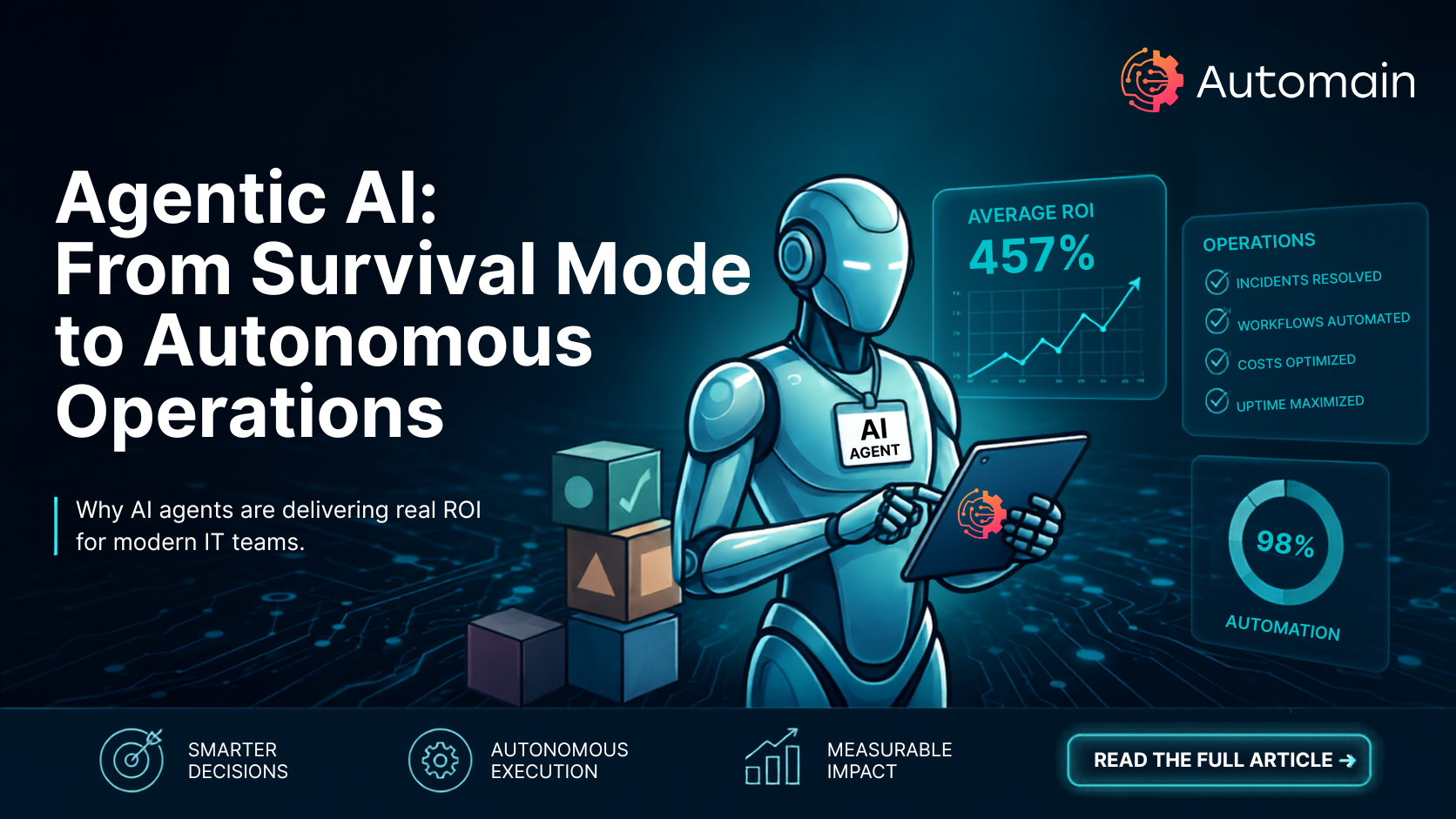
Transitioning from Traditional Monitoring to AI-Native Autonomous Operations
The limitation of modern enterprise operations isn’t a lack of data; it’s a context deficit.
Most organizations manage hybrid, multi-cloud environments using 20+ fragmented tools, resulting in over 1 million daily alerts. This “tool sprawl” creates a Data Value Gap where the volume of data grows exponentially, but the derived operational value plateaus.
At Automain, we’ve moved beyond traditional monitoring to an AI-Native Operating Model that solves this through a specialized Tri-Fabric architecture.
- The Power of Dynamic Graph-Based Topology
True AIOps requires more than just correlating timestamps. Our platform performs Automated Agentless Discovery to build a real-time GraphDB of your entire infrastructure.
How it works: Independent discovery pipelines extract normalized identifiers (IPs, MACs, BIOS UUIDs) and extract relationships from sources like vCenter, Kubernetes, and network controllers.
The Result: A unified Full-Stack Topology that maps application dependencies across all 7 layers in under 30 seconds, eliminating the need for manual, often outdated CMDBs.
- Moving from Chatbots to Autonomous Agents
While the industry is fixated on LLM-based chat, Automain focuses on Agentic AI—a framework where AI “Personas” operate as specialized digital workers.
The “Instruction Bookcase”: Using Prompt Templates, agents are given specific instruction manuals for tasks like Root Cause Analysis (RCA), capacity planning, or vulnerability assessments.
Universal Tooling: Through our Model Context Protocol (MCP), agents dynamically call tools (Splunk, ServiceNow, Ansible) to gather evidence and execute remediations.
Explainability: Unlike “black box” AI, every decision is tracked via Explainability Storyboards, providing a clear audit trail of why an agent reached a specific conclusion.
- Closed-Loop Automation and Noise Reduction
The goal is Zero-Touch Operations. Our Automation Fabric executes policy-driven, self-healing workflows.
90%+ Noise Reduction: By correlating millions of raw MELT data points (Metrics, Events, Logs, Traces) into a handful of actionable incidents.
Outcome-Based Workflows: Whether it’s TDM2IP migration for a Telco or predictive maintenance for a retail fleet, the system manages the lifecycle of the incident from detection to remediation.
Why This Matters!
As we support the digital objectives, the ability to scale operations without exponentially increasing headcount is critical. Automain allows for on-premises, air-gapped deployments to meet strict national data residency and security requirements.
The shift from “Survival Mode” to “Autonomous Operations” isn’t a luxury; it’s a prerequisite for the next era of digital competition. Organizations using this model see an average 457% ROI with a payback period of less than 4 months so capability adequate for routine tasks, inadequate for the complex operational scenarios that actually matter.