
Operations Debt: The Hidden Cost of Network Operations
Most conversations about network operations start with ALERTS.
They should start with work nobody logged.
Manual CMDB updates. Per-device scripts before every change. Multi-controller data pulls for executive reports. War rooms with 20 people because no single system holds the full context. Engineers reconciling inventory that was wrong before the incident even began.
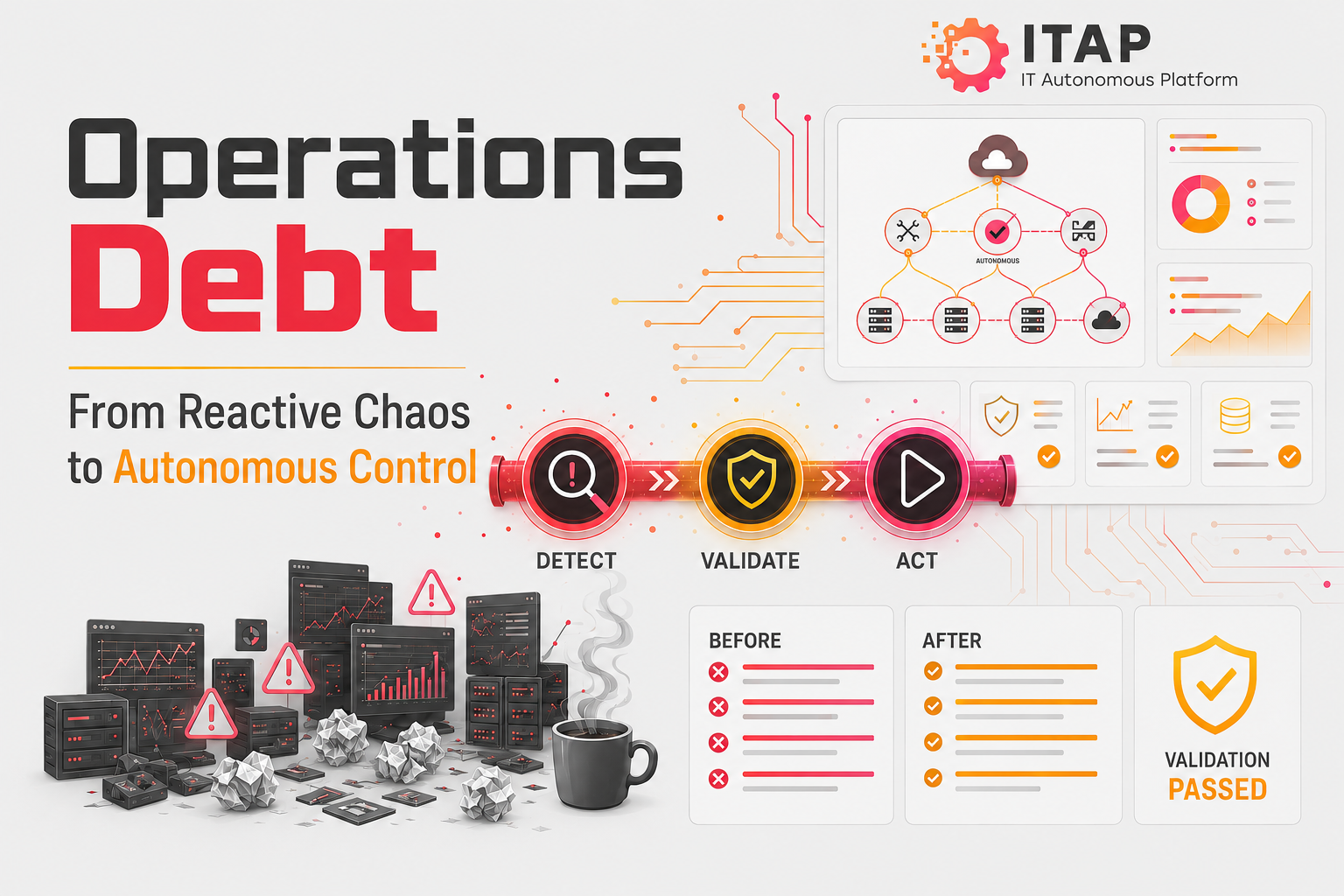
That is operations debt, the accumulated cost of running complex infrastructure on fragmented tools and human glue.
It does not appear on a capex slide. It does not trigger a P1 alarm. But in production deployments across telecom, healthcare, and enterprise IT, it shows up in the same places again and again: slow changes, bad decisions, repeated incidents, and teams that are busy but not scalable.
This article is about that debt, and what it takes to retire it.

Technical debt is a familiar idea: shortcuts today, pain tomorrow.
Operations debt is its operational twin:
-
- A CMDB that reflects ~30% of reality while leadership plans upgrades from it.
- Change validation that takes 8–16 hours of per-device scripting.
- Incident bridges that need 20–30 participants because context lives in separate tools.
- Executive reporting built by hand from multiple controllers every cycle
- New equipment onboarded over days because discovery and registration are manual.
None of this is “monitoring.” It is the tax of disconnected operations, paid in engineer hours, outage risk, and planning errors.
The outstanding importance of a modern operations platform is not that it shows more charts. It is that it retires this debt systematically, discovery, correlation, automation, and governance in one repeatable pipeline.

Capability 1: A system of record, not a spreadsheet with credentials
In one large healthcare environment, 7 data centers, 800+ facilities, 550,000+ network assets, the CMDB was not just outdated. It was a risk surface:
-
- Upgrade decisions based on stale inventory.
- Compliance assessed manually, point-in-time.
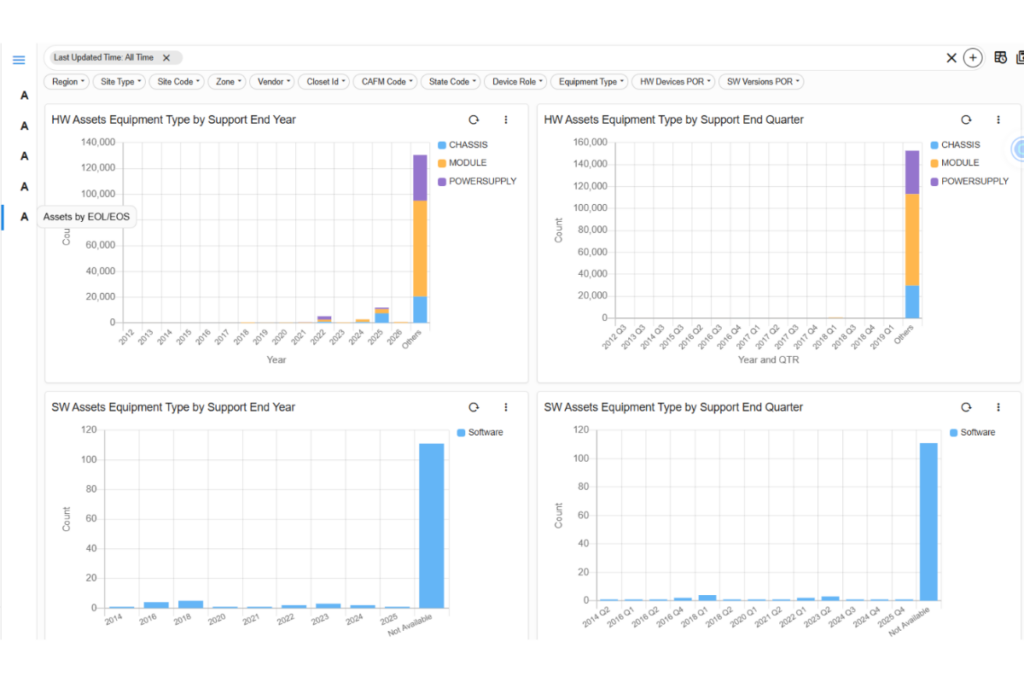
- No continuous view of EOL/EOS exposure across the estate.
After continuous automated discovery and reconciliation, CMDB accuracy moved from roughly 30% to 97%+. New devices were classified and registered in minutes, not days.
That is not a hygiene metric. It is decision quality:
-
- Fewer wrong upgrades.
- Faster modernization planning.
- Defensible risk prioritization.
- One source of truth for engineering, change, and audit.
Real impact: ~$8.1M measurable value over five years in that deployment, through productivity gains, OpEx reduction, decommissioning unused gear, and controlled upgrade scope.
Capability 2: Change management as an ROI engine, not a ceremony
Operations debt is most expensive where change is frequent and validation is manual.
In the same healthcare deployment, a standard access-switch migration required 8–16 hours of manual per-device work. Across ~400 changes in one year, that became:
-
- ~4,800 hours of engineer time.
- ~88% avoidable cost per change after automation.
- Validation windows reduced to 1–2 hours.
- ~$528K annual cost avoidance on change management alone.
The capability that mattered was not “AI.” It was automated pre/post comparison against a live system of record, replacing dispersed scripts and inconsistent data with one auditable workflow.
For CIOs and CFOs, this is often the clearest ITAP story: operations automation with a line-item ROI, not a NOC vanity metric.

Capability 3: Incident cost is a collaboration tax
When a tier-1 environment supporting thousands of global customers ran on 25+ tools, the symptom was alert volume. The cost was organizational:
-
- War rooms with 20–30 people per major incident.
- SLAs missed not because teams were slow, but because root cause was fragmented.
- Tickets opened on symptoms because no layer connected transport, core, and service context.
In carrier-scale deployments (80,000+ elements, phased over ~20 weeks), the shift was structural:
-
- Cross-domain correlation and automated root cause
- 68–98.5% alert noise reduction depending on domain
- MTTR from hours to ~22 minutes in multiple production environments
- 1,200+ ITSM tickets per month created, enriched, routed, and closed without Level-1 manual handling
The ROI here is capacity reclaimed: fewer bridges, smaller triage teams, faster restoration, not another dashboard subscription.

Capability 4: Fast value without platform paralysis
Operations debt grows when every new capability requires a monolithic upgrade, patches, restarts, long SI cycles.
ITAP’s composable solution-pack model (pipelines, policies, dashboards as importable bundles) changes the economics of adoption:
-
- Focused domains live in ~6 weeks (mobility, enterprise agents)
- Large phased rollouts in ~20 weeks across central office, transport, and data center
- New solutions added without platform restarts
That matters because operations debt compounds during long migrations. Teams need production value while legacy tools are still running, especially during Prime/PPM and regional EMS end-of-life transitions.

Capability 5: Agentic AI that pays down debt, without creating new risk
The newest form of operations debt is ungoverned AI. Modern AIOps platforms for network operations help organizations automate analysis while maintaining governance. Demos that copy all data into a lake, burn token budgets, and bypass change control.
A Fortune 500 energy deployment took the opposite path:
-
- Hybrid context without full data federation agents reason across Dynatrace, Splunk, ServiceNow, firewalls, campus, and WAN tools.
- Human-in-the-loop remediation where autonomy is not yet safe.
- Governed AI spend prioritization and cost controls on every invocation.
- ~80% of agent value in production within six weeks.
That is agentic AI as debt reduction: faster RCA, fewer tool hops, governed execution, not autonomy theater.

What to measure if you want the real business case
If you are evaluating any operations platform, skip the feature checklist. Audit operations debt directly:
What GOOD looks like:
Q: How accurate is your CMDB against live discovery?
A: 90%+ sustained, not a one-time project.
Q: How long does change validation take?
A: Hours, not days; automated pre/post.
Q: How many people join a typical severity-1 bridge?
A: Falling over time as context unifies.
Q: How many tickets are opened on symptoms vs. root cause?
A: Fewer, richer incidents.
Q: How long to onboard a new device into operations?
A: Minutes, automated
Q: Can you quantify savings beyond MTTR?
A: Yes, productivity, OpEx, risk avoidance
Across production deployments, those answers consistently cluster around:
-
- CMDB: ~30% → 97%+
- Noise reduction: 68% – 98.5%
- MTTR: up to ~90% improvement (often hours → ~22 minutes)
- Quantified 5-year value: ~$8M+ where asset and change scope are in play

The bottom line
The industry has oversold visibility.
What enterprises actually need is operational solvency: trustworthy inventory, fast and safe change, incidents understood in full context, and automation that closes the loop without bypassing governance.
That is the outstanding importance of this class of system, not more alerts handled, but less unpaid manual labor holding the network together.
ITAPs from Automain production pattern shows that debt can be retired measurably: in weeks, across domains, alongside the tools you already own, with ROI that finance can follow, not just NOC metrics engineering applauds.