
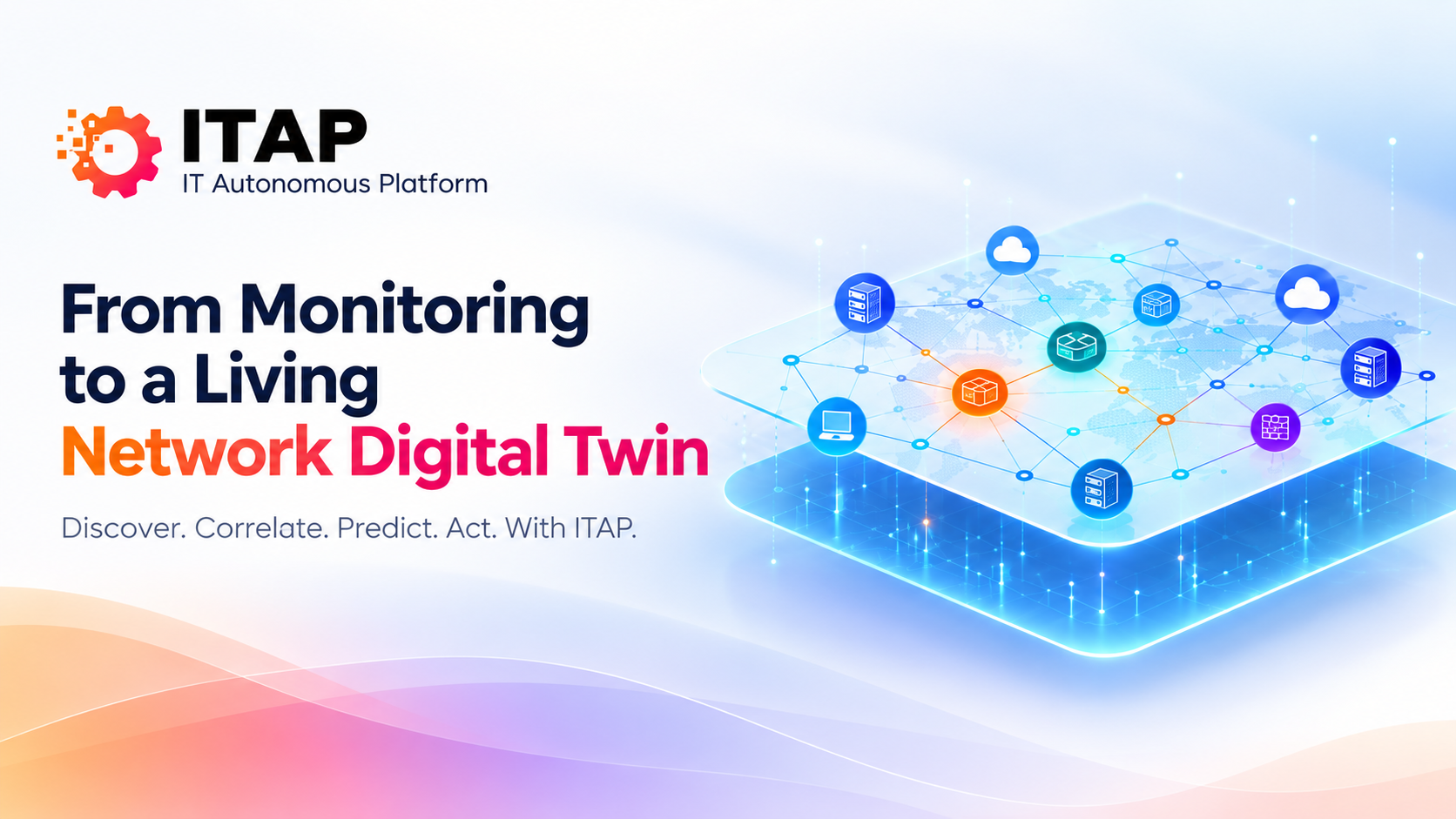
Modern enterprises run on networks that change every hour: new services, cloud moves, ACL updates, capacity shifts, multi-vendor fabrics. Yet many operations teams still rely on stale Visio maps, incomplete CMDBs, and siloed monitoring tools that see symptoms, not the living system underneath.
That gap is exactly where a Network and Infrastructure Digital Twin becomes strategic, and where ITAP (IT Autonomous Platform) platform, is designed to operate.
What a digital twin means in operations (not marketing)
In ITAP’s agentic model, a Network Digital Twin is not a pretty topology picture. It is a continuously updated operational model that:
- Discovers physical and logical infrastructure and relationships.
- Learns from telemetry, topology, and traffic patterns.
- Supports baselines, what-if, and predictive scenarios for service assurance and change.
- Grounds AI agents so decisions are explainable and tied to real dependencies.
ITAP explicitly positions Network Digital Twin for Service Assurance as a core agentic workflow, for example, agents that create a digital twin of the network and run baseline, what-if, predictive maintenance, and change scenarios (including ACL change impact) before risk hits production.
How ITAP builds the twin: discovery → graph → intelligence
Agentic layer: Digital Twin Agents + governed action: Beyond dashboards, ITAP provides collaborative agents, Event, Guardian, Digital Twin, Predictive Maintenance, Incident, and remediation agents, orchestrated with human-in-the-loop controls, guardrails, and explainable storyboards. For ITAP buyers, that means: simulate and recommend first; automate only on approved runbooks.
Live discovery, CMDB-independent by design: ITAP accommodates agentless discovery and enrichment patterns: inventory, neighbors, and dependency mapping without waiting for a “perfect CMDB.” Topology and relationships can be built from live sources (SNMP, SSH/CLI, APIs, controllers, IPAM/NCCM integrations such as Infoblox NetMRI, and more), then optionally synced back to CMDB later.
End-to-end topology as the twin’s skeleton: ITAP Network Observability provides automated mapping of devices and protocol relationships (CDP, LLDP, OSPF, BGP, ISIS), plus physical, logical, and geospatial views, path visualization, and application dependency mapping. That graph, stored and traversed in a topology GraphDB, is what turns “alerts” into “impact.”
Telemetry that keeps the twin honest: The twin stays current through multi-protocol ingest: SNMP, gNMI/gRPC, OpenTelemetry, Netconf/Yang, Kafka/NATS streams, BulkStats, and controller/APM/ITOM feeds. ITAP’s Data Fabric (1900+ bots, low-code pipelines) normalizes and routes MELT + inventory so the model reflects reality, not last quarter’s spreadsheet.
Topology-aware AIOps on top of the twin: In ITAP, topology correlation uses GraphDB relationships, node_id, node_type, layer precedence, to group related alerts, identify probable parent/root context, and create actionable incidents. The twin is not only for planning; it is the correlation engine for MTTR.

What leaders can actually do with it

Why this matters for regulated enterprises
For NOC, infrastructure, and digital operators, especially under Vision tie1/national-scale estates, the twin is a control-plane for confidence:
- Residency-ready deployment (on-prem / private cloud when required).
- Read-only first PoCs: prove detect + RCA on live feeds before automation.
ITAP’s job is clear: sit above your existing monitors, controllers, and ITSM as the correlation and decision layer, not a rip-and-replace.
The shift in one sentence
Stop treating the network as a black box you monitor after impact. Start operating a living twin you can discover, simulate, correlate, and govern, before the outage writes the narrative for you.

If your team is evaluating digital twins for network and infrastructure assurance, the next step is narrow and practical: pick one critical journey or fabric, connect 2-3 read-only sources, and measure time-to-evidence RCA and change blast-radius clarity.